 LOTUS
Thesis · November 1, 2026
The November 1, 2026 Inflection: An Evidential, Historical, and Unnerving Thesis on Global Cryptocurrency Adoption
A thesis, not financial advice. Every figure links to its source; read them, and decide for yourself.
Before you read
The whole thesis, in five breaths
- The claim: November 1, 2026 is the starting line of a long climb in global crypto adoption. Not because of hype, and not because one law switches on that day, but because several changes in late October cleared away what had been holding prices down.
- What changed in October's last ten days: the U.S. finalized its rules for digital dollars (stablecoins); Wall Street's main clearinghouse began turning about $30 trillion of stocks and Treasuries into blockchain tokens; the Federal Reserve paused interest rates; and two temporary brakes on prices ended on October 30.
- Why it will feel slow at first: nothing visibly flips on November 1. Bitcoin sits near $80,000, about 35% below its high, and traders are waiting out the November 3 midterm elections. Expect a choppy start.
- Why it is unnerving: this adoption is not people choosing crypto. It is being pushed from the top: by government debt, by new banking-network rules, by Wall Street's own systems, and by AI agents that already pay each other in digital dollars. Crypto is becoming financial plumbing people use without choosing it.
- How to read it: each section opens with a short summary like this one. The figures are as of late October 2026, and every one links to its source.
Thesis Statement: November 1, 2026 marks the structural starting line of an exponential bull run toward global cryptocurrency adoption—not because of retail euphoria or a single statutory decree taking effect that Sunday, but because it is Day One of the post-October structural clearance. Over the final ten days of October 2026, the global financial architecture quietly completed a foundational migration: the Office of the Comptroller of the Currency (OCC) finalized the federal rulebook for U.S. payment stablecoins under the GENIUS Act on October 211, the Depository Trust & Clearing Corporation (DTCC) activated live blockchain tokenization for $30 trillion in eligible U.S. securities on October 283, the Federal Reserve paused interest rates at 3.75%–4.00% despite persistent inflation on October 286, and two major mechanical suppressors—the $11 billion Deribit Bitcoin options expiration and the European Economic Area (EEA) MiCA stablecoin liquidation cutoff—cleared the market on Friday, October 309. When the calendar turns to November 1, 2026, the artificial brakes holding digital asset prices in compression are gone, leaving an illiquid crypto supply base exposed to institutional collateral mobility, sovereign fiscal debasement, legacy payment rail enforcement, and autonomous machine-to-machine commerce5.
To be brutally honest, it will look deceptively slow—and even fragile—at first. No federal law or central bank switch flips literally on Sunday, November 1, 2026; the OCC's final GENIUS Act regulations formally take effect on January 18, 202717, and SWIFT's mandatory ISO 20022 address validation hard-stop goes live on November 14, 202618. On November 1 itself, market sentiment remains bruised: Bitcoin is trading near $80,000–$81,200, roughly 35% below its October 2025 all-time high of ~$126,0004, "Uptober" has failed to materialize for the second consecutive year22, U.S. spot Bitcoin ETFs recently suffered sharp single-day outflows ($635.6 million on October 22 and $137.9 million on October 23)23, and Ethereum's Glamsterdam upgrade just faced a testnet postponement on October 22–25 due to a security finding on EIP-803725. Furthermore, institutional option sellers and liquidity providers are actively holding back supply until the November 3, 2026 U.S. midterm elections resolve near-term political uncertainty, leaving spot prices vulnerable to early-month whipsaws between $75,000 and $82,0009.
Yet what makes this thesis unnerving is that retail pessimism no longer drives the adoption curve. Previous cryptocurrency bull runs were speculative rebellions against traditional finance; the exponential adoption cycle beginning in November 2026 is a systemic integration of blockchain infrastructure by sovereigns, Wall Street clearinghouses, and non-human AI agents3. Driven by a $40.58 trillion U.S. national debt where annual net interest ($1.052 trillion) has overtaken national defense spending ($965 billion)30, a record $103.61–$104.32 trillion global M2 money supply32, SWIFT's November 14 expulsion of unstructured cross-border payment data18, and autonomous AI agents already executing over 138 million to 176 million on-chain transactions13, global crypto adoption is transitioning from an optional speculative trade into mandatory financial plumbing.
#1. The Evidential Case: Structural Clearance and the Supply-Demand Vice
The empirical case for November 1, 2026 rests on a stark divergence between surface-level price stagnation and deep-structural infrastructure deployment. Throughout October 2026, price action across digital assets was compressed by three temporary, mechanical headwinds that reached their terminal exhaustion point on October 30, just as institutional tokenization rails and on-chain supply lockups reached critical mass3.
#The Three Mechanical Brakes Ending on October 30, 2026
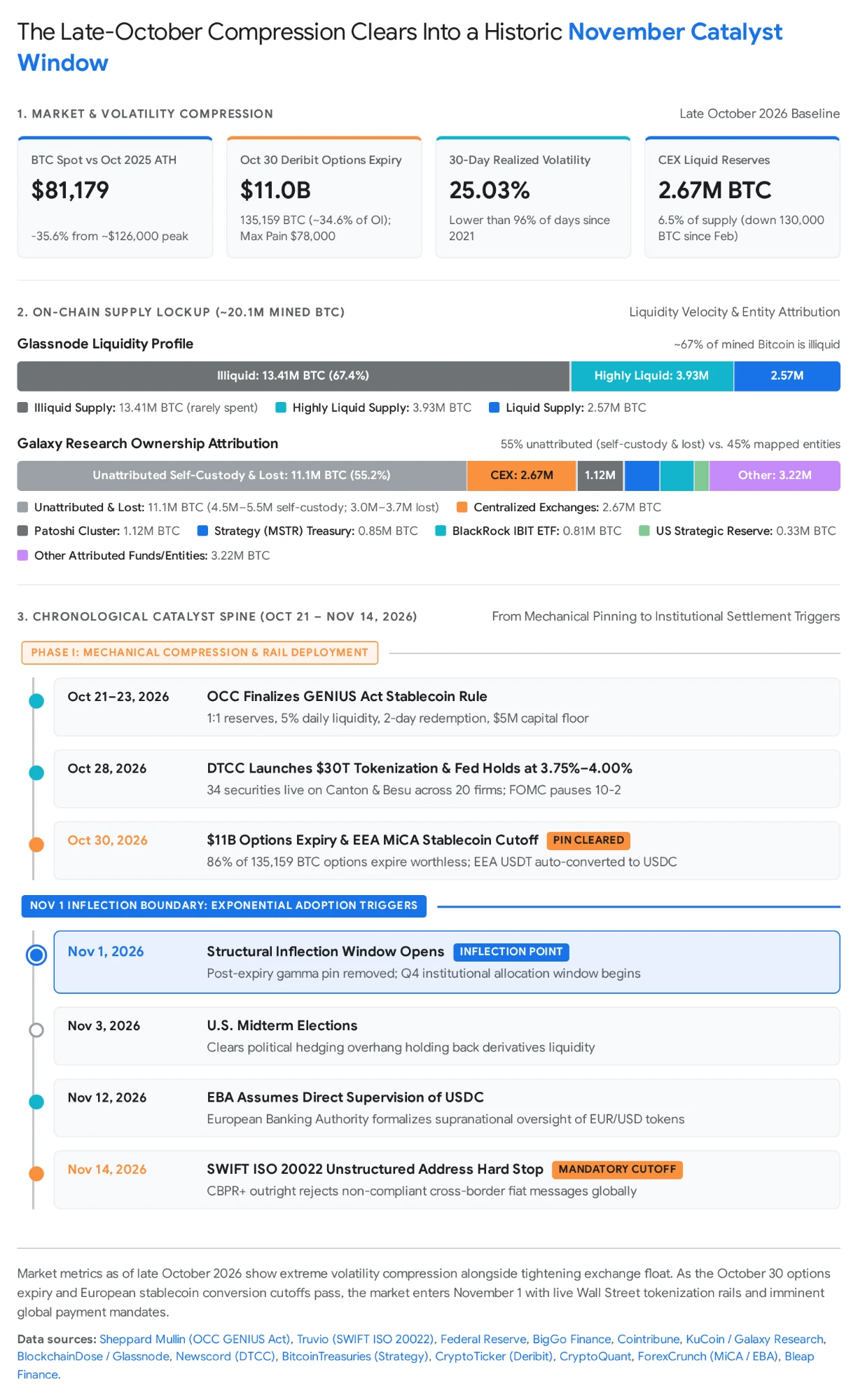
First, the $11 billion derivatives gamma pin dissolves. On Friday, October 30, 2026 at 08:00 UTC, 135,159 Bitcoin option contracts—representing roughly $10.92 billion to $11.1 billion in notional value and 34.6% of all open Bitcoin options interest on Deribit—reach expiration10. Because 70% of the expiring gamma is concentrated between $75,000 and $82,000, with the "max pain" settlement point sitting at $78,000, market-maker delta hedging has mechanically suppressed spot price excursions throughout October9. According to Deribit data analyzed by CryptoTicker, 86% of these 135,159 contracts (116,265 options)—including 58,717 call contracts stacked above $90,000 and 17,592 put contracts between $69,000 and $75,000—expire worthless10. This heavy dealer hedging compressed Bitcoin's 30-day realized volatility to 25.03, a level lower than on 96% of trading days since 202136. With CryptoQuant's all-exchange perpetual futures funding rates sitting at an uncrowded 0.0049% on October 22 (and ranging between 0.0017% and 0.0102% over the past month)36, the October 30 expiration removes a massive structural ceiling without leaving behind overleveraged long positioning.
Second, the European MiCA stablecoin forced-conversion drain concludes. Bears have pointed to the $12.73 billion contraction in total stablecoin market capitalization since May 22, 2026—slipping to roughly $298.0 billion–$300.36 billion by late October, with Circle's USDC losing $4.08 billion to $4.69 billion in 30 days and Tether's USDT shedding $1.25 billion in a single week—as evidence of capital flight17. That reading misinterprets a regulatory plumbing migration as a demand collapse. Under the European Union's Markets in Crypto-Assets (MiCA) enforcement schedule, major exchanges including Coinbase shut off EEA trading for non-compliant stablecoins (such as USDT, DAI, PYUSD, and Pax Gold) and set October 30, 2026 as the final withdrawal deadline before automatically converting remaining EEA customer balances into compliant tokens like USDC11. Pre-deadline institutional redemptions and cross-issuer rebalancing created temporary friction in headline circulating supply, even as enterprise and B2B payment velocity expanded underneath13. Once the October 30 conversion executes and the European Banking Authority (EBA) assumes direct supervision of USDC on November 12, 2026, European institutional liquidity can re-enter the market on supervised rails12.
Third, the Federal Reserve's pre-election pause stabilizes the macro liquidity floor. On October 28, 2026, the Federal Open Market Committee (FOMC), led by Chairman Kevin Warsh, voted 10–2 to maintain the federal funds target range at 3.75%–4.00% (with the interest rate on reserve balances held at 3.90% and the overnight reverse repo rate at 3.75%)6. Crucially, the FOMC's implementation directive confirmed that the New York Fed's Open Market Desk will continue to roll over at auction all principal payments from the Fed's $4.5 trillion in Treasury holdings, reinvest all agency security principal payments directly into Treasury bills, and purchase T-bills or short-term coupon securities (<3 years maturity) whenever necessary to maintain "ample reserves"6. By pausing rate hikes ahead of the November 3 midterms while keeping its liquidity backstop active, the Fed removed the immediate tail risk of an October monetary shock45.
#Wall Street's $30 Trillion Tokenization Engine and the GENIUS Act Lock-In
While derivatives and regulatory deadlines suppressed October spot prices, the institutional piping required for exponential global adoption went live in the final week of October 2026. Operating under a three-year SEC no-action letter, the Depository Trust & Clearing Corporation's subsidiary, the Depository Trust Company (DTC), launched its live Tokenization Service on October 28, 20263. At launch, the platform covers 34 eligible U.S. securities—spanning select large-cap Russell 1000 equities, ETFs, and U.S. Treasury bills, notes, and bonds—representing approximately $30 trillion in market value3. Twenty major Wall Street participants—including JPMorgan, Citigroup, Fidelity Investments, Citadel Securities, Morgan Stanley, Bank of America, Barclays, State Street, and UBS—have signed access agreements4. Connected initially to the public-permissioned Canton Network and DTCC's private Ethereum-client Besu blockchain (with Stellar and Circle's Arc network integrations scheduled for 2027), the service processes traditional-to-token conversions in 15 minutes or less during business hours and enables 24/7 peer-to-peer intra-chain transfers between DTC-registered wallets using a single unified CUSIP3.
Just days earlier, following the enactment of the Guiding and Establishing National Innovation for U.S. Stablecoins (GENIUS) Act in July 202513, the OCC issued its final implementing regulations on October 21, 2026 (published in the Federal Register on October 23, 2026, and taking effect January 18, 2027)1. In a major victory for institutional scalability, the OCC eased several restrictive proposals: it slashed the minimum daily liquidity requirement from 10% to 5% of reserve assets1, eliminated the requirement that large Permitted Payment Stablecoin Issuers (≥$25 billion) hold 0.5% of reserves (capped at $500 million) in insured bank deposits2, replaced bank-style Tier 1 capital ratios with a cleaner GAAP equity definition ($5 million ongoing floor plus a 12-month operational expense backstop, up to 50% fundable via qualifying debt)1, eliminated the automatic 7-day redemption extension when 24-hour redemptions exceed 10% of a brand's supply (maintaining a two-business-day redemption standard with discretionary OCC extensions)1, and dropped the rebuttable presumption against affiliate reward arrangements in favor of case-by-case supervisory review1. Simultaneously, the SEC proposed "Regulation Crypto Assets" in August 2026 to formalize investment contract rules while modernizing transfer agent regulations for blockchain tokenization49, and three companies formally notified the SEC on October 21, 2026 of their intention to launch tokenized equities trading53.
#The On-Chain Supply Vice
When institutional collateral mobility activates across a tightly constrained asset, price elasticity becomes highly sensitive to new inflows. As of October 2026, approximately 20.1 million Bitcoin have been mined, but the effective tradable float is near historic lows15. Centralized exchange reserves have dropped by 130,000 BTC (4.64%, worth ~$10.73 billion) since February 2026 to roughly 2.67 million–2.68 million BTC, representing just 6.5% of total supply according to Santiment and CryptoQuant reports53. On October 5 alone, 24,073 BTC left exchanges—the largest single-day net outflow since March 2026—while large wallets accumulated 86,702 BTC over a three-week span57.
Beyond exchange balances, Glassnode data as of October 8, 2026 indicates that 13.41 million BTC (~66.7% of supply) sit in "illiquid" wallets that rarely spend (compared to 2.57 million liquid and 3.93 million highly liquid BTC in March 2026), while 78.5% of all Bitcoin has remained inactive for at least six months, and long-term holders (>155 days) control roughly 16.3 million to 16.64 million BTC (~80% of supply)16. Complementing this, Galaxy Research's October 2026 ownership analysis finds that 55% of all mined Bitcoin (11.1 million BTC) resides in unattributed addresses—including an estimated 4.5 million to 5.5 million BTC in long-term personal self-custody and 3.0 million to 3.7 million BTC permanently lost15. Within the 9.0 million BTC attributed to known entities, massive tranches are structurally immobilized: the Satoshi-era Patoshi cluster holds 1,123,658 BTC that have never moved15; Strategy (formerly MicroStrategy) holds 848,517 BTC (worth $67.9 billion at a $64.02 billion cost basis as of October 19, 2026, or >4% of total 21 million supply)58; BlackRock's iShares Bitcoin Trust (IBIT) alone holds 814,263 BTC15; Strive holds 43,000 BTC ($3.5 billion)59; and the U.S. government holds an estimated 328,372 BTC (with ~198,000 BTC cleared through final forfeiture and locked under Executive Order 14233's "hold, do not sell" mandate)60.
#2. The Historical Case: Fourth-Quarter Regime Pivots Meet Sovereign Fiscal Dominance
History demonstrates that cryptocurrency adoption does not advance in a smooth linear progression; it moves in sharp fourth-quarter step-functions catalyzed by sovereign monetary debasement14.
#The Brutal Truth About November Seasonality and Cycle Pivots
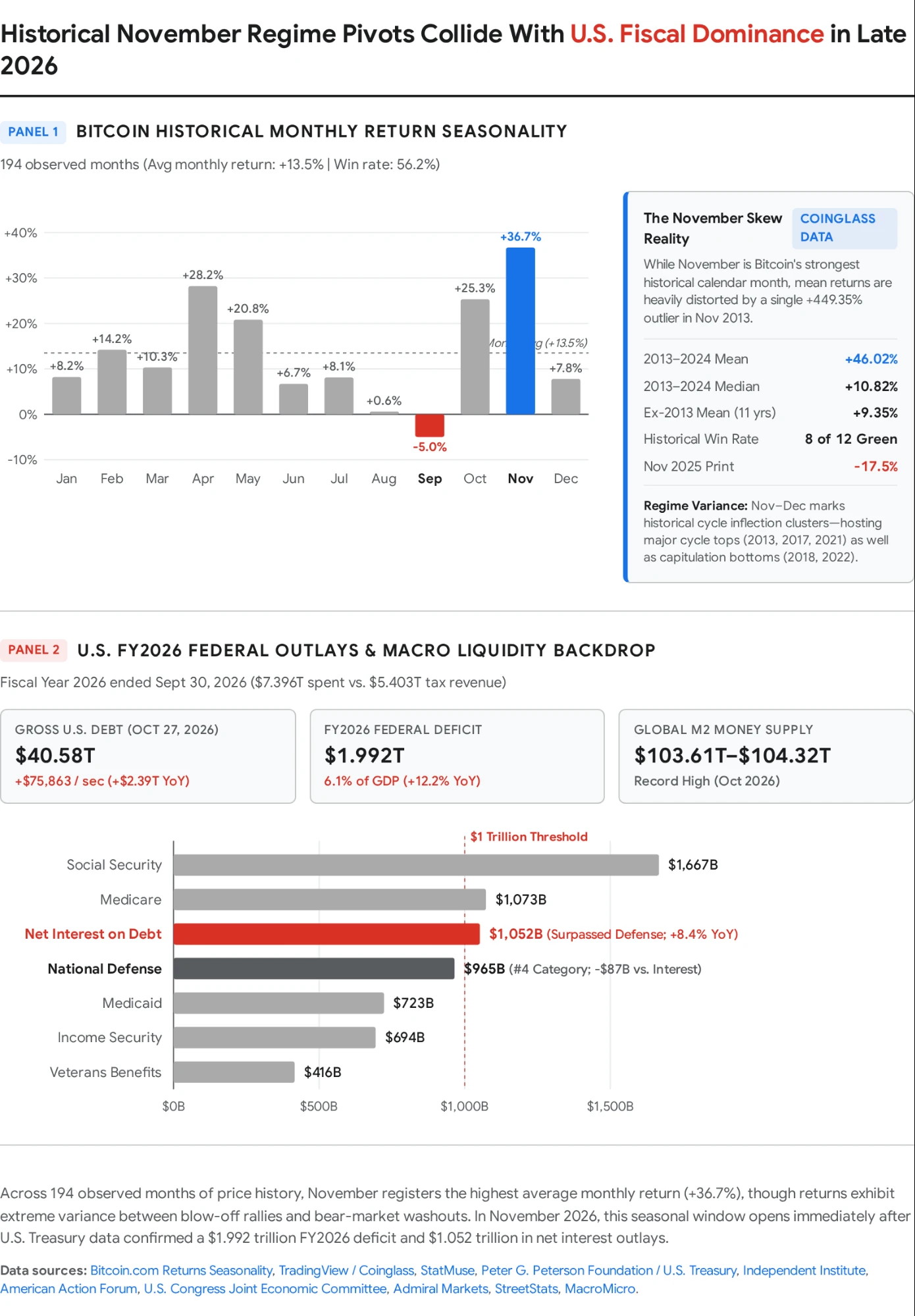
Across 194 observed months of Bitcoin price history tracked by Bitcoin.com, Bitcoin has finished positive 56.2% of the time (109 green months) with an overall average monthly return of +13.5%, and November stands as the single strongest calendar month on record with an average return of +36.7% (putting Q4 at an average quarterly return of +88.5%, second only to Q2's +154.8%)65. In Coinglass's 2013–2024 dataset highlighted by trader Daan Crypto Trades, November's simple average reaches +46.02%, finishing green in 8 out of 12 years: 2013 (+449.35%), 2014 (+12.82%), 2015 (+19.27%), 2016 (+5.42%), 2017 (+53.48%), 2020 (+42.95%), 2023 (+8.81%), and 2024 (+37.29%)64.
However, brutal honesty requires stripping away statistical illusion. First, November's +46.02% mean in the 2013–2024 Coinglass series is heavily skewed by November 2013's +449.35% outlier surge; when measured by median return across 2013–2024, November sits at a much more conservative +10.82%, and excluding 2013 reduces the simple average across the remaining 11 years to +9.35%64. Second, when November turns negative, the drawdowns are severe: 2018 (-36.57% on Coinglass / -34.7% on Bitcoin.com), 2019 (-17.27%), 2021 (-7.11%), 2022 (-16.23%), and November 2025 (-17.5%), which immediately followed Bitcoin's October 2025 cycle peak of ~$126,00020.
Why, then, does November 1, 2026 matter historically? Because, as market analysts observe, the November–December window is the historical regime-pivot engine of the entire cryptocurrency asset class—marking both the major cycle tops of 2013, 2017, and 2021 and the cycle capitulation bottoms of 2018 and 202264. In 2026, Bitcoin has already endured its post-peak correction: after peaking at ~$126,000 in October 2025 and sliding through H1 2026 to a June low near $63,000–$64,000, Bitcoin rebounded 43.8% over the late summer before consolidating near $80,000 in October 2026 (still down 25%–35% year-over-year)20. Entering November 1, 2026 after a full year of valuation reset means the seasonal volatility expansion is launching from a compressed mid-cycle base rather than an overheated blow-off top.
#The Macroeconomic Engine: Autopilot Deficits and the $104 Trillion Liquidity Wave
What transforms a seasonal Q4 pivot into a multi-year exponential adoption curve is the release of the U.S. Treasury's final fiscal year 2026 figures in mid-to-late October 202614. Those numbers indicate that the world's reserve currency issuer has entered a structural fiscal feedback loop. After first closing above $40 trillion on August 18, 2026, total gross U.S. national debt reached $40.25 trillion on October 5 ($117,707 per person or $298,606 per household, per the U.S. Congress Joint Economic Committee) and climbed to $40.58 trillion by October 27, 202631. Over the past year, the national debt expanded by $2.39 trillion—an average increase of $75,863 per second—putting the Treasury on pace to reach $41 trillion by approximately February 3, 2027 and approach the $41.1 trillion statutory debt limit established by the 2025 reconciliation act shortly thereafter70.
In FY2026 (ended September 30, 2026), the U.S. federal government collected $5.403 trillion in revenues (+3.2% YoY) but spent a record $7.396 trillion (+5.5% YoY), producing an annual budget deficit of $1.992 trillion (roughly $2.0 trillion or 6.1% of GDP, up $217 billion or 12.2% from FY2025's $1.775 trillion deficit)14. With mandatory entitlement spending accounting for 65% of all federal outlays and growing on autopilot68, and the average interest rate on marketable debt rising to 3.518% in September 2026 (up from 3.406% one year ago and 1.470% five years ago)70, net interest payments hit a record $1.052 trillion (gross interest $1.1 trillion) in FY2026, jumping 8.4%–8.5% from ~$970 billion in FY202514. For the first time, debt service is the third-largest federal expenditure behind Social Security ($1,667 billion) and Medicare ($1,073 billion), surpassing total spending on National Defense ($965 billion) as well as Medicaid ($723 billion), Income Security ($694 billion), and Veterans' Benefits ($416 billion), while consuming 19% of all federal tax receipts14. Under current law, the Congressional Budget Office (CBO) projects net interest will total $16.2 trillion over the next decade, rising to $2.1 trillion annually (25.8% of federal revenues) by 203630.
At the October 28, 2026 FOMC press conference, Chairman Kevin Warsh insisted there is "no soft inflation target" and noted that Q3 GDP growth likely exceeded 3% (following an upward revision of H1 2026 GDP growth to 2.4%)8. Yet inflation remains stubbornly above the 2% goal—August PCE inflation stood at 3.4%, Core CPI at 3.1% YoY, Core PCE at 2.9% YoY, PPI at 3.3% YoY, crude oil has swung between $74 and over $100 per barrel, and U.S. average residential heating oil prices surged 74% YoY to $6.19 per gallon in mid-October14. While two hawkish dissenters (Lisa Cook and Beth Hammack) voted to hike rates on October 28 and FedWatch prices a 75.1% probability of a 25 bps hike in December6, the bond market is already straining, with 2-year Treasury yields at 4.772%, 10-year yields crossing 5.028%, and 30-year yields hitting 5.329% on October 2845. Globally, central banks have continued expanding liquidity: Global M2 money supply reached an all-time high of $103.61 trillion to $104.32 trillion in late October 2026 (up 8.24% YoY across the four major central banks, which added $1 trillion in August alone, while U.S. M2 logged its 27th consecutive monthly increase in July and reached a record $23.34 trillion in August 2026)32. Whenever global M2 expands to record highs while sovereign fiscal math constrains sustained real-rate tightening, scarce digital assets historically absorb the liquidity overflow29.
#3. The Unnerving Case: Why Global Crypto Adoption Is Mandatory, Not Voluntary
The most important—and unnerving—insight of this thesis is how global cryptocurrency adoption actually happens starting in November 2026. Retail investors still imagine "global adoption" as billions of citizens voluntarily choosing self-custodied Bitcoin over fiat banks. The reality documented across late-2026 regulatory filings, payment network mandates, and on-chain flow data is far more clinical: global adoption is being propelled top-down by legacy payment exclusion, sovereign debt financing needs, geopolitical hoarding, and autonomous software agents18.
#1. The SWIFT ISO 20022 Panopticon and the Corporate Push Into On-Chain Rails
Two weeks after November 1, on November 14, 2026, the global correspondent banking network executes a hard cutoff that every multinational corporate treasury has been warned not to miss18. Under SWIFT's Cross-Border Payments and Reporting Plus (CBPR+) Standards Release 2026 (SR 2026), unstructured postal addresses are permanently removed from cross-border payment messages (alongside the end of legacy MT101 coexistence and mandatory admi.024 reception)18. Starting November 14, any cross-border wire, securities settlement, FX transaction, or trade finance message lacking structured or hybrid address fields (at minimum, distinct designated XML fields for town and country across all payment parties) will not merely be delayed or flagged—it will be rejected outright by the SWIFT network18.
This mandate is not merely an operational upgrade for straight-through processing; it directly enforces revised Financial Action Task Force (FATF) Recommendation 16 rules for global Anti-Money Laundering (AML) and Counter-Terrorist Financing (CTF) surveillance18. For thousands of emerging-market exporters, small-to-medium enterprises, and multinational subsidiaries operating with legacy ERP systems or in regions lacking standardized Western postal formatting, November 2026 brings immediate cross-border payment rejections, manual compliance freezes, and working-capital lockups18.
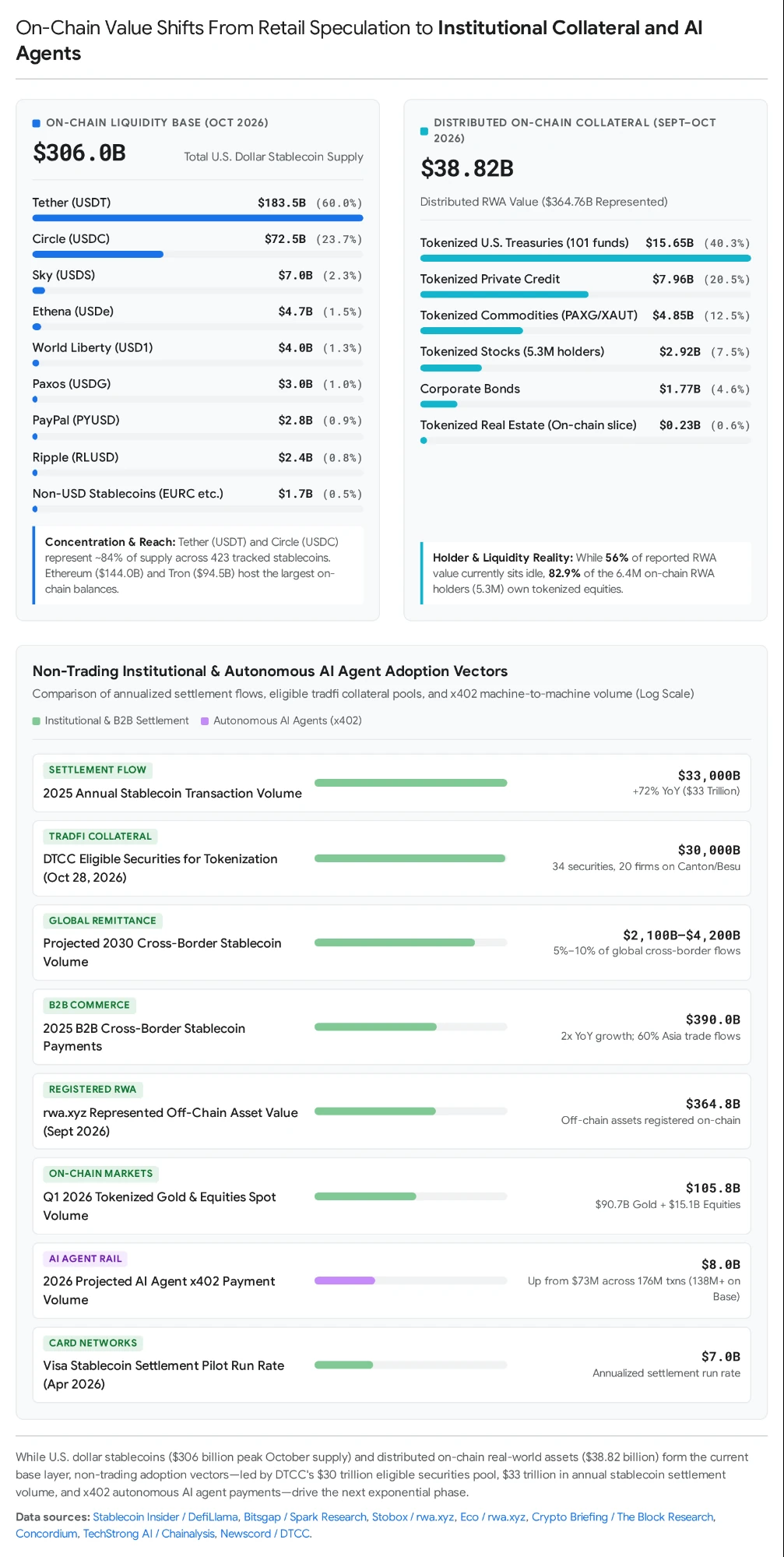
The result is an accelerating corporate migration toward stablecoin settlement rails—which industry reports note can settle remittances up to 500x faster than legacy cross-border corridors81—and alternative sovereign settlement corridors like the BRICS payment initiatives linking domestic fast-payment systems (such as India's UPI), local currencies, and CBDCs discussed at the 2026 BRICS Summit in India82. Even before this November 14 SWIFT cutoff, B2B cross-border stablecoin payments doubled year-over-year to $390 billion in 2025 (crossing $6 billion monthly by mid-2025, with 60% of flows in Asia and South Asia stablecoin volumes rising 80% to $300 billion between January and July 2025)13. Total annual stablecoin transaction volume reached a record $33 trillion in 2025 (+72% YoY, per Bloomberg)81, Visa's stablecoin settlement pilot accelerated from a $4.6 billion annualized run rate in Q1 2026 to $7 billion annualized in April 202613, crypto card spending topped $18 billion annualized in early 202681, and Chainalysis reports that cross-border stablecoin remittances from Canada to India, China, and the Philippines surged 141% YoY to $2.36 billion as users bypassed 6.7%–7.0%+ traditional bank remittance fees79.
#2. Stablecoins as a State-Sanctioned Captive Buyer for U.S. Debt
Why did the White House, the U.S. Treasury, and the OCC move so aggressively in 2025–2026 to enact and finalize the GENIUS Act while urging the Senate to pass the Clarity Act1? The unnerving macroeconomic explanation lies in the U.S. Treasury's need to finance $2 trillion annual deficits14. As Chainalysis's 2026 Geography of Crypto Report observes, the United States is executing a two-legged structural strategy: importing Bitcoin as digital gold while exporting USD stablecoins to proliferate the dollar globally, bolstering U.S. economic strength79.
Currently, U.S. dollar tokens account for 99.5% of the ~$306 billion global stablecoin supply tracked by DefiLlama in October 2026—led by Tether's USDT ($183.5 billion, ~60%), Circle's USDC ($72.5 billion, ~24%), Sky's USDS ($7.0 billion–$8.4 billion), Ethena's USDe ($4.7 billion), World Liberty Financial's USD1 ($4.0 billion), Paxos's USDG ($3.0 billion), PayPal's PYUSD ($2.8 billion–$3.6 billion), and Ripple's RLUSD ($2.4 billion)—while all non-dollar stablecoins combined (including ~$806 million in Euro tokens led by Circle's EURC at ~$526 million) total just $1.7 billion13. Under the OCC's final GENIUS Act rule announced on October 21, 2026, Permitted Payment Stablecoin Issuers (PPSIs) must back every token 1:1 with identifiable, segregated reserve assets1. Crucially, by eliminating the proposed requirement that large issuers (≥$25 billion) hold 0.5% of reserves in insured commercial bank deposits (parallel to the European System of Central Banks' September 22, 2026 call to end MiCA's 30%–60% bank-deposit reserve mandate)2, the OCC ensured that reserve growth flows heavily into short-term U.S. government securities rather than commercial bank deposits.
At the same time, the GENIUS Act strictly prohibits licensed issuers from paying interest or yield to holders solely for holding, using, or retaining payment stablecoins1. Consider the mechanics of that design: a global user holding a GENIUS-compliant USD payment stablecoin receives 0% direct yield from the issuer while absorbing the 2.9%–3.4% annual purchasing-power erosion of U.S. inflation1 (unless they move into decentralized lending protocols like Aave v3 at ~3.70% APY or yield-bearing synthetic/vault tokens like Sky's sUSDS at ~3.60% APY or Ethena's sUSDe, which averaged ~11.8% trailing 90-day APY in April 2026)13. Meanwhile, the U.S. Treasury gains a captive global buyer of short-term debt, with Spark Research projecting stablecoin supply to reach $420 billion by the end of 2026 and industry estimates projecting stablecoins to handle 5%–10% of global cross-border payments ($2.1 trillion to $4.2 trillion) by 203013. Simultaneously, on-chain tokenized U.S. Treasury and money market funds—led by BlackRock's BUIDL ($2.4B–$3.1B), Circle's USYC ($2.6B–$2.9B), Ondo's USDY ($2.1B–$2.23B), and Franklin Templeton's BENJI/iBENJI ($1.7B–$2.05B)—have expanded to $14.7 billion–$15.65 billion across 76 to 101 products84, anchoring a broader tokenized RWA market that has reached $38.6 billion–$46.2 billion in distributed on-chain value (and $358 billion–$369 billion in represented underlying assets) across 36 blockchains84.
#3. The Rise of the Non-Human Economy: AI Agents on x402 Rails
Perhaps the most unnerving driver of exponential crypto adoption in late 2026 is that humans are no longer the sole growth demographic for on-chain transactions. Autonomous artificial intelligence agents cannot walk into a bank branch, pass human KYC checks, or navigate human-centric credit-card checkout screens88. They require native, programmable, machine-speed money.
In May 2025, Coinbase launched x402, an open payment protocol that turns any API endpoint into a machine-navigable paywall enabling instant stablecoin payments directly over HTTP28. On February 11, 2026, Coinbase rolled out dedicated Agentic Wallets for non-human actors91, and by July 2026, Visa, Mastercard, Stripe, Cloudflare, AWS, and 40 other major organizations had joined the x402 Foundation or implemented x402 payment rails for APIs, Model Context Protocol (MCP) servers, and AI agents28. According to industry data cited by Bitsgap, autonomous AI agents processed roughly $73 million across 176 million transactions between May 2025 and April 2026, with full-year 2026 autonomous agent payment volume projected around $8 billion13. Chainalysis separately confirmed in October 2026 that AI agents have completed more than 138 million cryptocurrency transactions on Coinbase's Base blockchain alone34.
Even more remarkably, Chainalysis's 2026 Geography of Crypto Report reveals that AI agents are now paying other AI agents: one of the largest transaction categories on x402 is autonomous payment for AI model inference (where American wallets account for 88% of volume, while Chinese-funded agents account for just 0.1% of model inference payments), alongside market and financial intelligence (46.7% share), payment and settlement rails (35% share), gaming, token issuance, and agentic tooling79. Recognizing the speed of this shift, CFTC Commissioner Selig warned on October 28, 2026 that AI will rapidly accelerate fully autonomous trading, calling for a regulatory overhaul to supervise machine-speed markets where per-transaction human review is impossible27.
#4. Geopolitical Game Theory and Sovereign Bitcoin Hoarding
At the base layer, the weaponization of legacy banking rails and the freezing of foreign exchange reserves by political decree have triggered a sovereign game-theory race for unconfiscatable digital scarcity29. Following President Trump's March 6, 2025 signing of Executive Order 14233 establishing the U.S. Strategic Bitcoin Reserve and U.S. Digital Asset Stockpile60, sovereign and sub-sovereign accumulation has moved from fringe theory to formal state policy:
| Sovereign / State Entity | Estimated BTC Holdings (2026 Trackers) | Acquisition Strategy & Legal Status |
|---|---|---|
| United States (Federal) | 328,372 BTC total (~198,000 BTC cleared forfeiture)60 | Executive Order 14233 (signed March 6, 2025) mandates "hold, do not sell" for forfeited BTC60. The proposed BITCOIN Act of 2025 (S. 954) seeks to purchase 1M BTC over 5 years using $6B/yr in Fed remittances with a 20-year hold63. |
| China | 190,000–194,000 BTC60 | Historical judicial and law enforcement seizures held by state authorities60. |
| United Kingdom | 61,245 BTC (up from 61 BTC in earlier partial counts)60 | Law enforcement seizures; managed under seized-asset frameworks without a formal hold-only reserve doctrine yet61. |
| Ukraine | 46,351 BTC (public trackers; 1,200 BTC in earlier state estimates)60 | Sovereign and public-official attributed holdings tracked in 202661. |
| El Salvador | 6,174–7,734 BTC (~$600M value in mid-2026)61 | First legal-tender adopter (Sept 2021) and daily 1 BTC DCA buyer61. Removed legal-tender mandate and phased out Chivo wallet in Jan 2025 under a $1.4B IMF deal, but continues daily BTC accumulation63. |
| United Arab Emirates | 6,420 BTC61 | Sovereign-linked mining and strategic accumulation61. |
| Bhutan | 4,973 BTC61 | Sovereign hydroelectric mining converting stranded renewable energy into dynamically managed reserve assets61. |
| Kazakhstan | 3,544 BTC61 | Energy-backed sovereign accumulation61. |
| U.S. States (TX, NH, AZ) | Funded & Statutory State Reserves60 | Texas enacted and funded S.B. 21 (June 22, 2025); New Hampshire enacted HB 302 (May 6, 2025, allowing treasury purchases of assets >$500B market cap); Arizona enacted HB 2749 (unclaimed property routing); 17 states have bills under consideration60. |
While no supranational body like the IMF or G20 has endorsed Bitcoin as a reserve asset—and El Salvador's experience in February 2026, when a price drop wiped roughly $300 million off its paper reserve value overnight, illustrates the volatility risk—the strategic disadvantage of holding zero digital assets has already forced nation-states and U.S. state treasuries off the sidelines29.
#4. Brutal Honesty: The Friction Points and Why the Run Starts Slow
An intellectually rigorous thesis must confront the counter-evidence head-on. Why will the exponential bull run starting November 1, 2026 feel slow, choppy, and contested in its opening days? Five real-world frictions documented in late October 2026 must be navigated:
| Friction Vector | Late-October 2026 Empirical Reality | Short-Term Impact (Early Nov 2026) | Long-Term Resolution / Bull Catalyst |
|---|---|---|---|
| 1. U.S. Midterm Election Uncertainty (Nov 3, 2026) | Polymarket prices a 65% probability of a Democratic sweep vs. 29% for a split Congress95. Bloomberg's Markets Pulse survey projects median year-end 2026 BTC at $90,800 under Republican control, $84,100 under divided government, and $76,450 under Democratic control9. | Option sellers are holding back new supply until Nov 3, leaving BTC vulnerable to dealer hedging swings into the $75,000–$78,000 gamma pocket9. | Regardless of the Nov 3 outcome, federal agencies (OCC, SEC, CFTC) are already executing rules under existing statutory authority49, and the $2T fiscal deficit remains unchanged14. |
| 2. December 8–9 FOMC Rate-Hike Threat | Despite pausing at 3.75%–4.00% on Oct 28, FedWatch prices a 75.1% probability of a 25 bps rate hike in December due to >3% Q3 GDP growth and sticky 2.9%–3.4% inflation8. | Elevated 10-year Treasury yields (5.028%) and a strong dollar cap immediate speculative multiple expansion for high-beta altcoins23. | Every 25 bps hike accelerates the $1.052T+ federal net interest spiral30, reinforcing the sovereign fiscal dominance trade and institutional allocation into BTC and yield-bearing RWAs13. |
| 3. Tokenized RWA Illiquidity & Concentration | While broader RWA token counts hit $70.32B across 50 CoinGecko tokens, 37% ($26.03B) hangs on a single credit product (Figure HELOC), 33.2% ($23.32B) are infrastructure tokens, and 56% of reported RWA value sits idle84. | Issuing a token does not automatically create secondary liquidity; DTCC's $30T service initially restricts conversions to business hours4. | DTCC's 24/7 intra-chain wallet transfers across 20 Wall Street firms and $524.8B in Q1 2026 RWA perpetuals volume demonstrate that institutional collateral velocity is rapidly scaling4. |
| 4. Ethereum Glamsterdam Testnet Delay | On October 22–25, 2026, Ethereum developers postponed the October 26 Hoodi testnet activation (and 200M gas limit hike) of the Glamsterdam upgrade (ePBS EIP-7732 & Block-Level Access Lists EIP-7928) due to an EIP-8037 state-pricing security finding25. | ETH has lagged near $2,320–$2,388 amid $224.96M in weekly ETF outflows21, delaying mainnet L1 parallel-processing scaling into late Q4 2026 or 202725. | Ethereum still commands 47.9% of all RWA value and $144.0B in stablecoins81, while Solana ($5.19B in RWAs as of Oct 29; 1.7M RWA addresses) and Canton absorb near-term retail and institutional tokenization flow3. |
| 5. Stablecoin Treasury Clearing Deadlines | Stablecoin issuers face a December 31, 2026 U.S. Treasury clearing deadline (and June 2027 repo phase) alongside the January 8, 2027 ESMA final wind-down deadline in Europe40. | Continued issuer rotation out of unregulated offshore tokens into regulated onshore wrappers (USDC, PYUSD, RLUSD, USDG)17. | Consolidates stablecoins into audited, federally supervised banking and payment rails under the GENIUS Act and EBA oversight1. |
#5. Synthesis: The Post-November 1 Chronology of Exponential Adoption
When you step back from daily candle charts and examine the structural calendar of late October and November 2026, the thesis comes into sharp focus. Between October 21 and October 30, 2026, the legacy financial system finalized the legal rulebook for digital dollars (the OCC's GENIUS Act final rule)1, connected $30 trillion of core Wall Street equity and Treasury collateral directly to blockchain networks (DTCC's Tokenization Service on Canton and Besu)3, confirmed that the U.S. government is borrowing $2 trillion a year while paying over $1.05 trillion in net interest14, paused monetary tightening at the Federal Reserve6, and purged $11 billion in derivative options gamma alongside Europe's non-compliant stablecoin overhangs10.
November 1, 2026 is the first day the market wakes up on the other side of that structural threshold. Over the first two weeks of November—moving through the November 3 U.S. midterm elections9, the November 5 Zcash NU7 network upgrade26, the November 12 EBA takeover of direct USDC supervision in Europe12, and the November 14 SWIFT ISO 20022 unstructured-address rejection deadline18—the quiet accumulation of illiquid Bitcoin (where 6.5% exchange reserves meet institutional and sovereign lockups)15 converges with the expanding utility curve of tokenized collateral (now reaching 6.4 million on-chain RWA holders, 82.9% of whom hold tokenized equities, per The Block Research)99 and autonomous x402 AI agents28. It will begin quietly in the plumbing of clearinghouses, corporate ERPs, and HTTP headers on November 1—and by the time retail sentiment realizes the regime has shifted, the exponential adoption curve will already be underway.
Works cited
- OCC Finalizes GENIUS Act Rules for Payment Stablecoin Issuerssheppard.com
- OCC Finalizes GENIUS Act Rule for Permitted Payment Stablecoinwilmerhale.com
- DTCC Launches Tokenization Service on Canton Network and Private Besu Blockchain: how 11 outlets framed itnewscord.org
- DTCC Launches Tokenization for 34 Securities Worth $30 Trillionbitcoinfoundation.org
- DTCC Tokenization Servicedtcc.com
- Federal Reserve issues FOMC statementfederalreserve.gov
- Fed leaves interest rates unchanged despite inflation in the USaljazeera.com
- Federal Reserve keeps rates unchanged despite elevated inflationapnews.com
- Bitcoin Braces for $11 Billion Options Expiry as Midterm Elections Loomfinance.biggo.com
- 11 billion dollars expire on Friday: is a Bitcoin setback coming?cryptoticker.io
- Coinbase delists USDT and DAI on October 30 - CoinStatscoinstats.app
- Two dates that decide the EU stablecoin market - Forex Crunchforexcrunch.com
- Stablecoin Supply: A Leading Market Signal? (2026 Data) - Bitsgapbitsgap.com
- U.S. Treasury: FY 2026 Deficit Totaled $2 Trillionamericanactionforum.org
- October 2026 Bitcoin Ownership Report: Why 11.1 Million BTCkucoin.com
- Bitcoin Supply Is Tighter Than The Headlines Suggestblockchaindose.com
- USDC supply shrinks by $4.08 billion - CryptoTickercryptoticker.io
- ISO 20022 Payment Format Changes: What's Due November 2026truvio.com
- ISO 20022 in bytes for payments: Call-to-action for November 2026swift.com
- What Bitcoin ETF flows reveal about institutional confidencem.economictimes.com
- Bitcoin hovers near $80,000 and Ethereum at $2,370 as macro uncertainty and weak institutional flows weigh on crypto marketsm.economictimes.com
- Bitcoin falls below $80,000 as Fed meeting, AI spending fears and oil prices weigh on crypto marketshindustantimes.com
- Bitcoin trades near $79,000 as Fed rate uncertainty, selling pressure weigh on crypto marketsm.economictimes.com
- Bitcoin price $81,568 after $431m liquidations - CryptoTickercryptoticker.io
- Glamsterdam Hoodi Testnet Announcementblog.ethereum.org
- Ethereum Upgrade After Glamsterdam: What Hegotá Holdscryptoticker.io
- $11 Billion of Bitcoin Options Set to Expire Oct. 30, Raising Volatilityen.bloomingbit.io
- x402 Explained: The HTTP Payment Protocol for AI Agentsconcordium.com
- What is a Bitcoin Strategic Reserve? 2026 Sovereign BTC Guidekucoin.com
- Interest Costs on the National Debt - Peterson Foundationpgpf.org
- US National Debt Tops $40 Trillion: Why Interest Mattersadmiralmarkets.com
- US & Global M2 Money Supply - StreetStatsstreetstats.finance
- World - M2 Money Supply of Major Central Banks - MacroMicroen.macromicro.me
- AI Agents Drive Surge in Crypto Payments, with U.S. Leading Adoptiontechstrong.ai
- $10.92 billion in Bitcoin options are set to expire on October 30, withkucoin.com
- $11.1 Billion in Bitcoin Options Expire October 30, With Max Pain Atbinance.com
- Stablecoin Market Sheds $12.7B as Crypto's Dry Powder Runs Thinnews.bitcoin.com
- The stablecoin market cap declined by $2.39 billion.stablecoinbeat.com
- Stablecoin Market Cap Chart, Supply & Peg Data - DefiLlamadefillama.com
- Crypto exchange Starts a 19 Day USDT Countdown - openPR.comopenpr.com
- Crypto News, Price Predictions, Best Exchanges - CryptoTickercryptoticker.io
- Coinbase Sets October 30 Deadline for Restricted Stablecoins in EEAkucoin.com
- Transcript of Chairman Warsh's Press Conference, October 28, 2026federalreserve.gov
- What the Fed's Balance Sheet Could Mean for the Debtbipartisanpolicy.org
- October 2026 Fed Meeting: Updates and Commentarykiplinger.com
- Unlocking $30 Trillion in Real-World Assets for Institutional Marketskucoin.com
- DTCC Launches Blockchain Tokenization Service for $30 Trillion in Eligible Securitieskucoin.com
- DTCC Launches Tokenization Service for $30 Trillion in U.S.coincodex.com
- 2026 Lookback: Shaping Digital Asset Rules Through CCI'scryptoforinnovation.org
- Rule - Federal Registerfederalregister.gov
- SEC Proposes Regulation Crypto Assets, White House Hosts Cryptopaulhastings.com
- SEC Proposes New Regulation Crypto Assets - YouTubeyoutube.com
- The Amount of Bitcoin on Exchanges Is Shrinking. Is a Rally Imminent?bitcoinmagazine.com
- The Bitcoin halving: Supply and Demandbitcoinsuisse.com
- Bitcoin Exchange Reserves Drop 130000 BTC, Fueling Talk of afinance.biggo.com
- Bitcoin (BTC) Exchange Reserves Fall to 2.68 Million BTC, Lowestpro.edgex.exchange
- Bitcoin Reserves on Exchanges Continue to Decline - Cointribunecointribune.com
- Strategy Inc. Bitcoin Guide: Inside the Largest Corporate BTC Treasurystealthex.io
- Strategy - Bitcoin Holdings & Analysisbitcointreasuries.net
- U.S. Strategic Bitcoin Reserve - Wikipediaen.wikipedia.org
- Cryptocurrency Reserve by Country (2026): Who Has a ... - Bleapbleap.finance
- Strategic Bitcoin Reserve: How the US Reserve Works and Where Itblofin.com
- Bitcoin Strategic Reserves: Which Nations Are Accumulating BTCspark.money
- November Preview: Will Bitcoin Break The Cycle Or Repeat It?tradingview.com
- Bitcoin Returns Seasonality - Monthly, Quarterly & Day-of-Weekcharts.bitcoin.com
- Bitcoin November Returns Last 10 Years | StatMuse Moneystatmuse.com
- Bitcoin Price Prediction for October 2026247wallst.com
- Autopilot Deficits: News Articleindependent.org
- Treasury Confirms $2 Trillion Deficit for Fiscal Year 2026crfb.org
- National Debt Reaches $40.25 Trillion, Increased $2.39 Trillion Yearjec.senate.gov
- Deficit Tracker - Bipartisan Policy Centerbipartisanpolicy.org
- National Deficit | U.S. Treasury Fiscal Datafiscaldata.treasury.gov
- U.S. debt interest tops $1 trillion as deficit nears $2 trillionpublicdebtnet.org
- Fed holds interest rates steady before elections, with two dissentswashingtonexaminer.com
- United States Money Supply M2 - Trading Economicstradingeconomics.com
- US M2 money supply surged +$102.8 billion in July, to a recordreddit.com
- Bitcoin to Attract More Capital as Money Printing Continues, Analysttradingview.com
- Global Money Supply Hits $103 Trillion: Could Rising Liquidity Pushcryptorank.io
- 2026 North America Crypto Adoption: $3.02T, Agentic Railschainalysis.com
- ISO 20022 milestone for November 2026: Unstructured addresses toswift.com
- Stablecoin Statistics 2026: 50 Key Figures (Oct Update)stablecoininsider.org
- BRICS looks to build new corridors for cross border paymentsthedigitalbanker.com
- BRICS Summit 2026: Dedollarisation by other methods? What RBI'swionews.com
- RWA Market Size 2026: $38.6B On-Chain · State of RWA - Stoboxstobox.io
- Tokenized RWA Market Size 2026: $20B+ AUM Growth Trajectoryeco.com
- Tokenized US Treasuries Hold $14.7 Billion as RWA Market Expandsu.today
- RWA.xyz Records $46.2 Billion Tokenized Assets Across 36 Chainsonebullex.com
- Coinbase Business | Get Paid by AI Agentscoinbase.com
- x402 Protocol Explained: How AI Agents Pay Onchain | Support - Ecoeco.com
- Introducing x402: a new standard for internet-native paymentscoinbase.com
- Coinbase's Agentic Commerce Play: x402 & AI Agent Wallets - Autheoautheo.com
- x402 Payments 2026: Coinbase, Stripe & Alternatives - Wavect.iowavect.io
- Strategic Bitcoin Reserve: How the US Reserve Works and Where Itblofin.com
- National Bitcoin Reserves: Which Countries Have Them and Why inbitnovo.com
- DTCC Brings $30 Trillion in Eligible Securities to Blockchaincryptorank.io
- Real World Assets explained: what RWA really arecryptoticker.io
- Ethereum's Glamsterdam upgrade: What it means for Institutions andcolossus.digital
- Solana’s RWA Market Hits Record $5.19 Billion as Tokenization Gains Momentumkucoin.com
- Tokenized stocks now account for 82% of onchain RWA holderscryptobriefing.com
- Stablecoin Issuers Face December 31 2026 Treasury Clearingonebullex.com